
Building Surge Capacity Planning Without Overbuying
Healthcare equipment demand rarely moves in a straight line. A respiratory program may run steadily for months, then face a sudden increase in discharges, seasonal respiratory volume, facility overflow, emergency response needs, or a repair backlog that strains ventilator availability.
For HME providers, healthcare facilities, hospice organizations, transport teams, public health agencies, and government stakeholders, the challenge is not just having more equipment. It is preparing for unpredictable demand without tying up capital in inventory that may sit idle.
That is where surge capacity planning becomes a practical operating discipline. A strong plan separates baseline need from surge need, defines rental and redeployment triggers, and builds equipment readiness into the model before demand spikes.
At Trace Medical, we support organizations with ventilator rentals, biomedical services, stockpile management, preventative maintenance, equipment tracking, and patient-ready readiness programs. Our role is to help teams balance availability, utilization, financial discipline, and operational flexibility.
What Is Surge Capacity Planning for Medical Equipment?
Surge capacity planning for medical equipment is the process of determining how much equipment to own, rent, maintain, stage, and redeploy so an organization can respond to demand spikes without excessive idle inventory. It helps teams balance equipment availability, patient readiness, utilization, cost control, and flexibility.
Why Surge Capacity Planning Is Harder Than It Looks
On paper, healthcare equipment planning can seem straightforward: estimate demand, add a cushion, and purchase enough equipment to cover the gap. In practice, ventilator surge capacity is more complicated.
Demand may shift because of seasonal illness, hospital discharge timing, hospice census changes, facility overflow, transport needs, regional emergencies, or supply constraints. A provider may own enough equipment in theory but still face a gap if units are out for repair, undocumented, not staged, or not appropriate for the patient’s needs.
Surge planning also affects several teams at once. Clinical teams need patient-ready ventilators that match care requirements. Operations teams need visibility into inventory, repairs, storage, and redeployment. Finance and procurement teams need to avoid capital tied up in underused equipment. Emergency preparedness teams need confidence that staged or stockpiled assets can be deployed when needed.
Overbuying may feel safer, but excess inventory creates its own burden. Stored ventilators still require:
Maintenance
Calibration
Software updates
Service records
Cleaning
Storage space
Tracking
Readiness checks
If those requirements are not managed, an organization may have equipment on paper without usable capacity in the field.
The Problem with Planning Around Peak Demand Alone
Peak-demand planning usually starts with a reasonable concern: what if we do not have enough equipment?
That question matters. No organization wants to delay care, strain staff, or miss a discharge because respiratory equipment is unavailable. But buying for the worst-case scenario can create a fleet sized for rare peaks rather than normal operations.
The hidden costs add up. Ventilators need maintenance, updates, accessories, documentation, storage, and lifecycle oversight whether they are used daily or only occasionally. Equipment can age in storage. Manufacturer support may change. Service records may fall out of date.
This is why a balanced model often works better than a purchase-only approach. Owned assets may support predictable core demand. Rentals can cover temporary or uncertain increases. Backup equipment can protect continuity during repairs or patient transitions. Managed stockpiles can support emergency preparedness when they are tracked, maintained, and reviewed.
A ventilator is not useful capacity simply because it exists. It becomes useful when it is maintained, documented, configured, staged, and ready for the right care setting.
A Practical Planning Model for Volatile Demand
A practical surge capacity planning model should be simple enough to use during normal operations and clear enough to guide decisions under pressure.
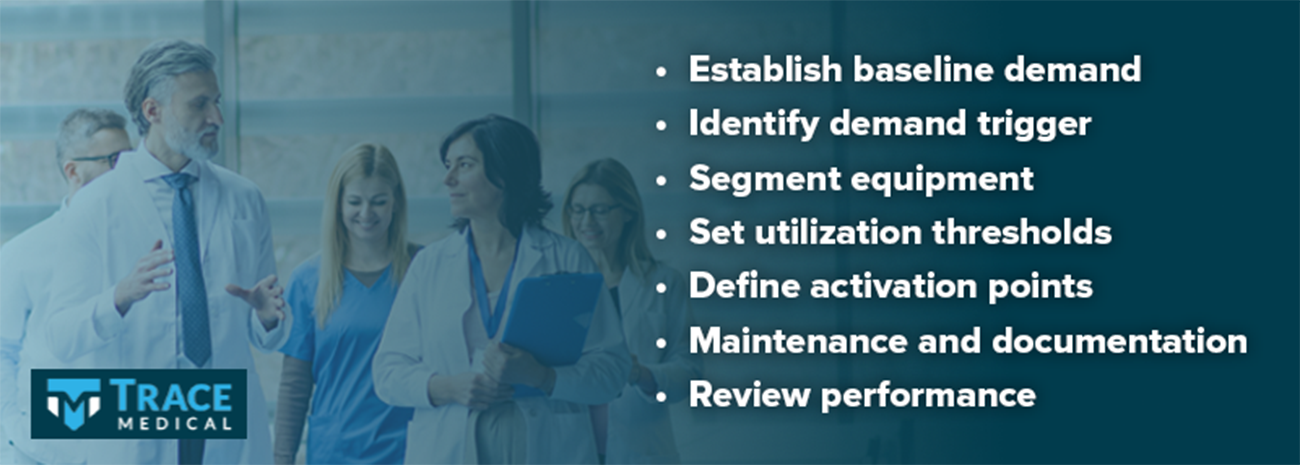
Establish baseline demand: Define the equipment needed for normal operations using actual utilization, patient volume, discharge patterns, device mix, repair frequency, and historical demand.
Identify demand triggers: Document the events that typically create pressure, such as seasonal respiratory volume, facility overflow, census changes, emergency response, discharge spikes, or service backlogs.
Segment equipment by owned, rented, backup, and stockpiled assets: Assign each category a clear role so teams know which equipment supports baseline use, temporary demand, replacement needs, or emergency readiness.
Set utilization thresholds: Decide when current capacity becomes too tight. For example, a program may begin evaluating rentals once a defined percentage of owned ventilators is deployed.
Define rental activation points: Build a ventilator rental strategy around clear triggers, such as projected census increases, pending discharges, repair delays, seasonal patterns, or staffing constraints.
Build maintenance and documentation into the plan: Include preventative maintenance, calibration, software updates, cleaning, service records, patient-ready checks, and deployment documentation.
Review performance after each demand shift: After a surge or unexpected gap, review utilization, missed triggers, downtime, service tickets, rental timing, staffing impact, financial impact, and redeployment performance.
Related Reading: Getting Started with Biomedical Services: What to Assess Before You Build or Outsource
Separate Baseline Need from Surge Need
A common HME inventory planning mistake is treating all demand as if it belongs in the same category.
Baseline need is the predictable volume required to support ongoing patients, regular referrals, and normal program activity. Surge need is temporary, seasonal, uncertain, or tied to a specific event. When these categories are blended together, organizations may purchase equipment for demand that may not last.
For an HME provider, baseline need may include ventilators consistently required for active home-based respiratory patients. Surge need may come from a sudden referral increase, hospital discharge spike, or seasonal respiratory illness pattern.
For a facility, surge need may involve overflow beds, higher-acuity patients, or temporary capacity expansion.
For government and public health teams, it may involve staged equipment for emergency response.
A useful structure includes:
Core capacity: equipment needed for predictable demand.
Flexible capacity: equipment used when demand rises above normal levels.
Contingency capacity: equipment staged for emergency, backup, or stockpile use.
This helps finance teams avoid buying for every possible scenario while giving operations and clinical teams a clearer path when volume changes.
Decide What to Own, Rent, or Stage
Once baseline and surge needs are separated, the next step is deciding which equipment belongs in each access model.
Owned assets often make sense for stable, high-utilization equipment that supports predictable demand. Rentals can be a better fit for temporary demand, uncertain growth, seasonal volume, pending discharges, repair coverage, or situations where access is needed without long-term capital commitment.
Backup equipment protects continuity when devices are pulled from service, patient needs change, or deployment timing becomes compressed. Stockpiled assets support emergency preparedness, but they require active management. A stockpile plan should answer more than “How many units do we have?” It should answer, “How many patient-ready ventilators can we deploy, and how quickly can we prove readiness?”
For organizations evaluating stockpile management, the plan should define where assets are located, how they are tracked, how often they are inspected, what service is required, and what must happen before deployment.
Build Readiness Into the Equipment Plan
Surge capacity depends on readiness, not just availability.
A ventilator sitting in storage may need maintenance, calibration, software updates, cleaning, documentation review, accessory checks, battery evaluation, or repair before it can be used. If those steps are discovered only when demand spikes, the plan becomes reactive at the worst possible time.
Equipment readiness should account for preventative maintenance, service documentation, calibration, testing, software updates, cleaning, patient-ready checks, asset location visibility, and redeployment workflows.
This is especially important for ventilators and POCs assigned to backup or stockpile roles. The longer equipment sits between deployments, the easier it is for readiness assumptions to drift.
At Trace Medical, we treat equipment readiness as part of capacity planning because access without maintenance, documentation, and deployment control leaves too much uncertainty in the system.
Set Rental Triggers Before Demand Spikes
A rental strategy works best when decision points are established before demand becomes urgent. If teams wait until every owned ventilator is deployed and discharges are pending, rental decisions become more reactive and harder to control.
Rental triggers give teams a shared framework. A trigger may be based on utilization, such as activating a rental review when a defined percentage of owned ventilators is deployed. Another trigger may be tied to upcoming discharges, projected census, regional demand, repair backlogs, or staffing constraints.
Common triggers include projected census above baseline capacity, multiple pending discharges, repair delays, seasonal volume, facility overflow planning, emergency preparedness activation, or temporary need for specialized ventilator models.
A thoughtful ventilator rental strategy should support the larger capacity model. It should help teams preserve capital, maintain access, and respond to volatility without turning every demand increase into a purchase decision.
Review the Plan After Every Demand Shift
Surge capacity planning should not be a static document. Demand patterns change. Patient acuity changes. Staffing changes. Equipment ages. Repair timelines shift. Procurement priorities evolve.
After a meaningful demand shift, teams should review what happened.
Did utilization thresholds provide enough warning?
Were rental triggers activated at the right time?
Did equipment availability affect patient transitions?
Were devices unavailable due to maintenance, repair, or documentation gaps?
Were stockpiled assets truly patient-ready?
The answer is not always to buy more equipment. Sometimes the better adjustment is earlier rental activation, improved tracking, a tighter maintenance cadence, or a clearer redeployment workflow.
Related Reading: Designing Ventilator Programs That Support Efficiency and Patient Outcomes
Surge Capacity Works Best When Teams Plan Together
Medical equipment surge planning should not live only in procurement.
Clinical leaders understand patient needs, device compatibility, respiratory workflows, and care transitions. Operations leaders understand tracking, storage, service workflows, deployment bottlenecks, and redeployment timing. Finance and procurement leaders understand utilization, capital planning, rental spend, cash flow, and total cost of ownership. Emergency preparedness teams help define contingency scenarios and escalation pathways.
When those perspectives come together, surge planning becomes a working model that connects patient continuity, equipment readiness, financial discipline, and operational execution.
Planning for Flexibility Without Losing Control
Volatile demand does not have to force organizations into overbuying. It does require a deliberate model.
The strongest plans define baseline need, identify surge scenarios, set utilization thresholds, establish rental activation points, maintain patient-ready assets, and review performance after demand shifts. Rentals and stockpile management are not replacements for planning. They are tools within the plan.
At Trace Medical, we support organizations with ventilator rentals, HME rentals, facility rentals, transport rentals, hospice rentals, preventative maintenance, government support, stockpile management, and equipment readiness programs.
Whether your team is refining an existing fleet strategy or building a more flexible model for unpredictable demand, we can help evaluate how owned assets, rentals, readiness support, and redeployment planning fit together.
FAQs About Surge Capacity Planning
What is surge capacity planning in healthcare?
Surge capacity planning in healthcare is the process of preparing people, processes, space, supplies, and equipment for demand that exceeds normal operations. For respiratory equipment, it includes determining how many ventilators to own, rent, stage, maintain, and redeploy.
How can healthcare organizations avoid overbuying ventilators?
Healthcare organizations can avoid overbuying ventilators by separating baseline demand from surge demand, tracking utilization, setting rental triggers, and confirming whether backup or stockpiled assets are patient-ready.
When should ventilator rentals be included in capacity planning?
Ventilator rentals should be included when demand is temporary, uncertain, seasonal, or difficult to forecast. They can also support pending discharges, facility overflow, repair backlogs, emergency response, or program growth.
What makes a stockpiled ventilator patient-ready?
A stockpiled ventilator is patient-ready when it has been properly maintained, tested, cleaned, documented, updated, tracked, and staged for deployment.
How often should a surge capacity plan be reviewed?
A surge capacity plan should be reviewed after major demand shifts, seasonal volume changes, emergency activations, service disruptions, or meaningful changes in patient mix, staffing, referral volume, or equipment utilization.